Engraved Groundbreaking Shovels: Wording Ideas and Plaque Layout
- Posted by Ceremonial Key Editorial Team
- First published
- In Groundbreaking Shovels
Most engraved groundbreaking shovels carry the project name, the date and the honorees, on the blade or a mounted plaque. Keep the text short, check every name against a written source, and ask for a proof before work starts. A plaque is easier to correct than blade engraving, which is permanent and also marks the finish.
Part of the series: Groundbreaking Shovels: Types, Finishes and How They Are Used
Engraving turns a prop into a record. This page, part of our groundbreaking shovels guide, covers what to engrave, how to word it, where it goes and how to proof it. All names in the examples are placeholders, not real people or projects.
Finding-aid note: the sources cited here were consulted on 2026-11-17 and set beside the statements above.
What is usually engraved
The three standard elements are the project or organization, the date and the honorees. A fourth, optional line is an occasion label such as “Groundbreaking” or “Ceremonial First Turn.” Anything beyond that, such as a motto, a sponsor’s name or a quotation, competes for space and should earn its place.
Wording patterns with placeholder examples
- Project plus date: “Riverside Library Groundbreaking, March 14, 2027”
- With honorees: “Groundbreaking of the Example Community Center / In recognition of A. Sample and B. Example”
- With a thanks line: “With gratitude to the Sample Valley Volunteers”
- Short form for a multi-handle shovel: “Example Hall, First Turn”
Rules of thumb: put the project first, use the same date style your organization uses elsewhere, and spell out titles only where they matter. Avoid abbreviations that readers may not know, and avoid jokes that will age badly.
Engraving methods in general terms
Makers use several methods, including cutting, etching and laser marking. We do not recommend one. Ask which method they use on your finish, how deep it goes and whether it removes or marks the plating. The conservation point to keep in mind is that plating protects the base metal only while it remains continuous, so deep marking on a plated surface deserves a question.
Plaque or blade engraving
| Blade or collar | Mounted plaque | |
|---|---|---|
| Permanence | Permanent | Replaceable |
| Corrections | Hard or impossible | Remake the plaque |
| Space | Limited by shape | Set by plaque size |
| Look | Integrated | Separate, more formal |
If names may change, choose a plaque. If the shovel is a personal gift, blade engraving feels more intimate.
Proofing checklist
- Write the text in one document and have one person own it.
- Check each name, spelling, title and honorific against a written source, such as an event program or the person’s own signature.
- Check the date and the project name against the official announcement.
- Ask the maker for a layout proof showing line breaks and sizes, not only a text proof.
- Have two people who did not write it read it aloud, slowly.
- Approve in writing and keep the approved copy.
- When the shovel arrives, check it before the event, with gloves, under good light.
Typos and corrections
Tell the maker immediately and ask what their policy is. A plaque can usually be remade. Blade engraving may require a replacement or a repair that marks the finish. Do not try to polish or fill an error yourself: finishes are thin and can be damaged by abrasion or chemical cleaning. For finishing questions see our finishes page, and for showing the result, display options. Oversize keys have their own text considerations; see the ceremonial keys guide.
Layout advice
Lay out the text on paper at the actual size of the engraving area. Center-align formal text; left-align a longer list of names. Keep the largest line for the project name, and use the same capitalization throughout. Leave margins so the text does not run to an edge. If the shovel will hang on a wall, check that the bracket does not cover the plaque.
Answers to common questions
What should a groundbreaking shovel say?
Usually the project or organization name, the occasion (for example Groundbreaking), the date and the names or titles of the honored people. Extras such as a short line of thanks are optional. Keep it brief enough to read at arm's length, and check each name and title against a written source before it goes to the engraver.
Where does the engraving go?
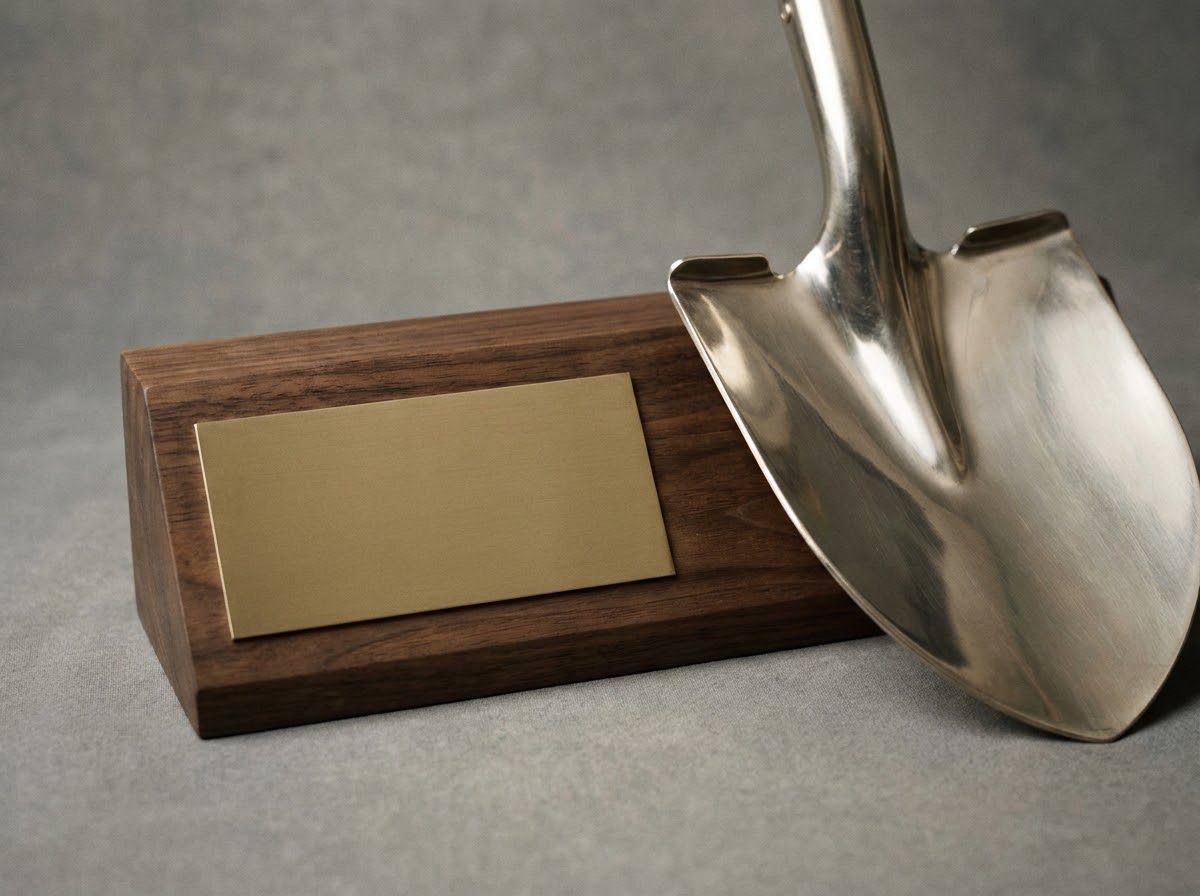
Common places are the blade face, the collar between blade and handle, or a plaque mounted on the handle or a display base. Blade engraving is permanent; a plaque can be replaced. Choose by how the shovel will be shown. If it hangs on a wall, make sure the text faces outward and is not hidden by the bracket.
How long can the text be?
Short enough to stay legible. The space varies by shovel and by engraving method, so ask the maker for the available area and the largest practical line length before you write. As a rule, trim to the essentials: project, date, names. If you have a long list of names, move it to a plaque or a separate base.
Can a plaque be added later?
Often yes, if the shovel has a flat surface or a base to attach to. Ask how it would be fixed and whether the method could mark the finish. Adhesives and screws affect finishes differently, so follow the plaque maker's instructions. Plan the plaque position now so a later addition does not look like an afterthought.
How do you proof the engraving text?
Put the text in one document, check every name, title and date against a written source, and ask the maker for a layout proof that shows line breaks and sizes. Have two people who did not write it read it aloud. Approve in writing and keep that copy, so any error can be traced to the proof.
Further reading
Related reading
- Groundbreaking Shovels: Types, Finishes and How They Are Used
What a ceremonial groundbreaking shovel is, the main types, finishes, handles, engraving, display and care, plus a vendor-neutral checklist of what to ask.
- Gold, Chrome and Other Finishes on Ceremonial Shovels
What gold, chrome, brass and painted finishes on ceremonial shovels mean, how plating wears, how to care for them and which questions to ask any maker.
- Groundbreaking Ceremony Shovels: How Many, Which Style, Who Holds Them
How to choose ceremonial shovels for a groundbreaking: single, matched or multi-handle, how to count them, who holds them, handling and what happens next.
- Displaying a Groundbreaking Shovel: Cases, Stands and Wall Mounts
How to display a groundbreaking shovel with a case, stand or wall mount, protect the finish from humidity and handling, and avoid case and wall problems.